Two storey L shaped brick built factory of C.1900
The Ordnance Survey maps for 1886 and 1914 show two different footprints for this site, the earlier one showing a rectangular block with a division, the later shows the L shaped building. Large sliding loading doors to ground and first floors with diagonal lifting gantry at first floor level.
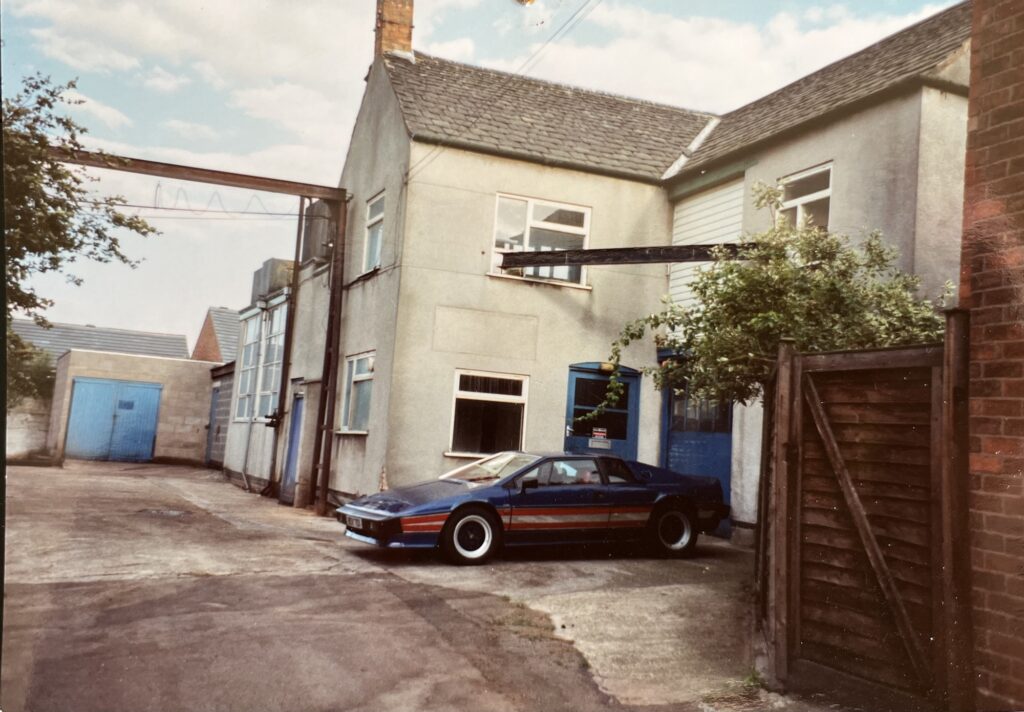
The factory, Station Road in the early 1990’s.
Built to the rear of no.12 Station Road with earlier? cobbled yard to front. To the rear was Joe Biddles garden, then an L shaped stable block to the left, a brick built C.1850 two storey barn was opposite the factory forming an open fronted quadrangle, the barn was directly behind 10 Station Road. Who built and owned it (Littlethorpe House or Biddle maybe?) what was it built for, boot and shoe? hosiery? engineering? The earliest occupant of the factory I can find was Broler Motors, they were a partnership between L.Brooks and Cyril Trasler, hence Broler. They made 2-stroke motorcycle engines. Cyril trasler and his wife are recorded as living nearby in the 1921 census. The business was in liquidation by 1924 as reported in the Leicester Daily Mercury of 31st March 1924, after which Cyril Trasler and his wife emigated to Canada.
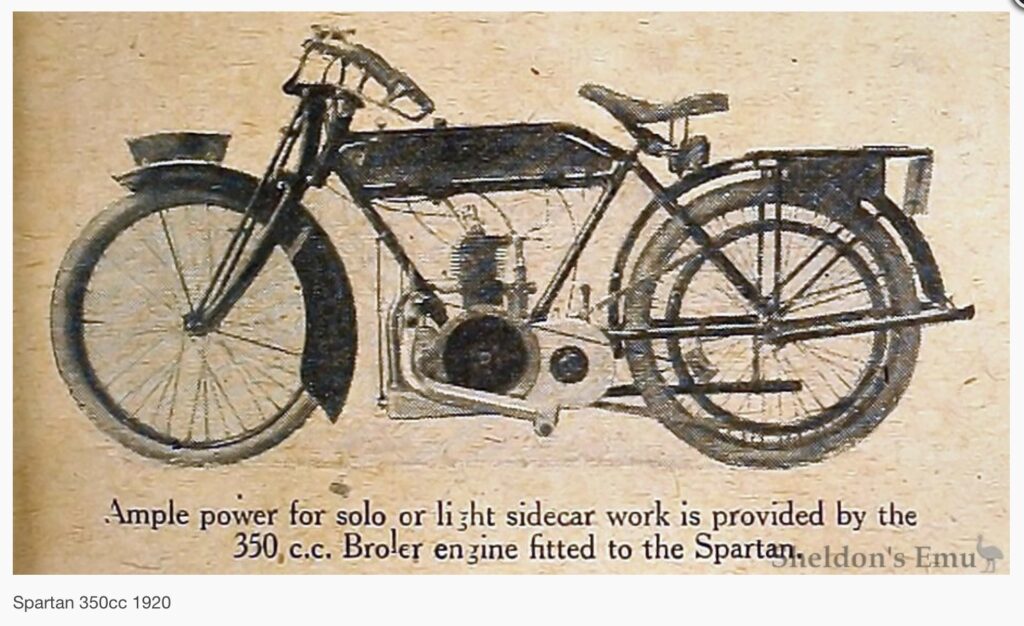
One of the 350cc Motorcycles.
It would appear that they also started The Heatproof Black Company sometime in 1923, the first advertisement appearing in The London Weekly Despatch in September 1923.
The Leicester Evening Mail of 13th May 1925 reports the registration of a new company at Littlethorpe called Heatproof Black Co. Ltd., with Brooks wife Sarah as a director, along with H.Cox of Station Road, Narborough. See clipping left. Numerous adverts were placed in both local and national newspapers on a regular basis. These lasted until 1935 when the business was offered for sale at a “low price” in The Leicester Mercury dated 17th September that year.
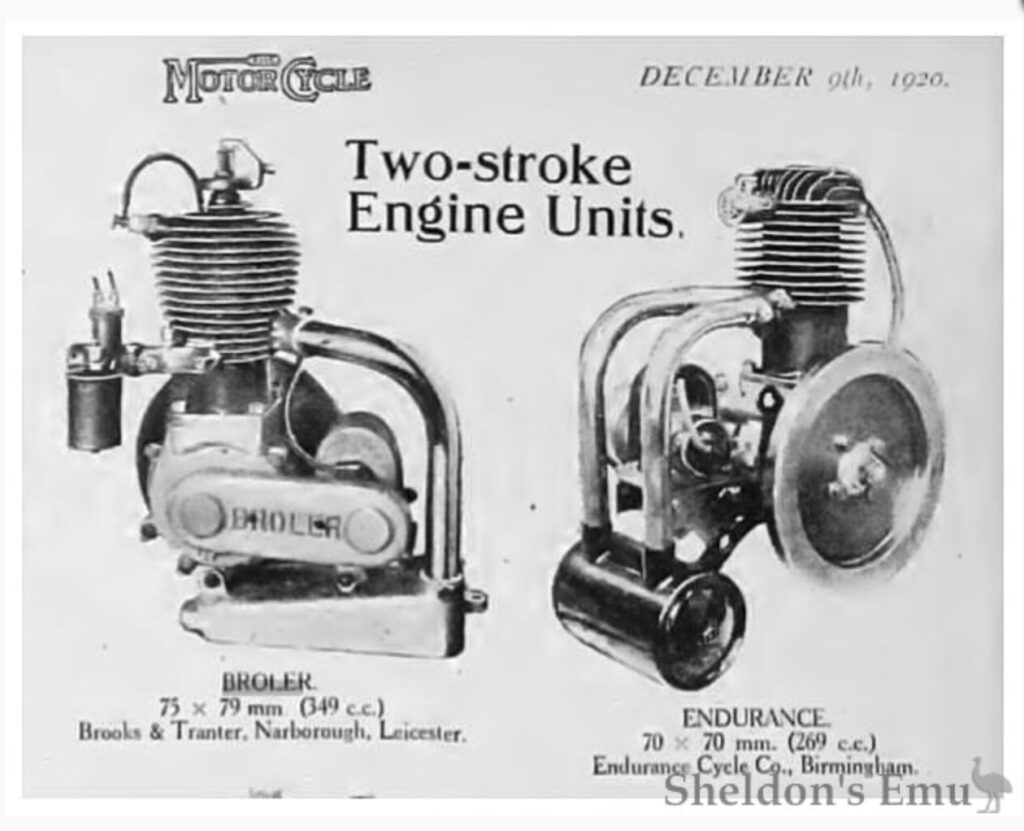
From The Motorcycle December 9th 1920.
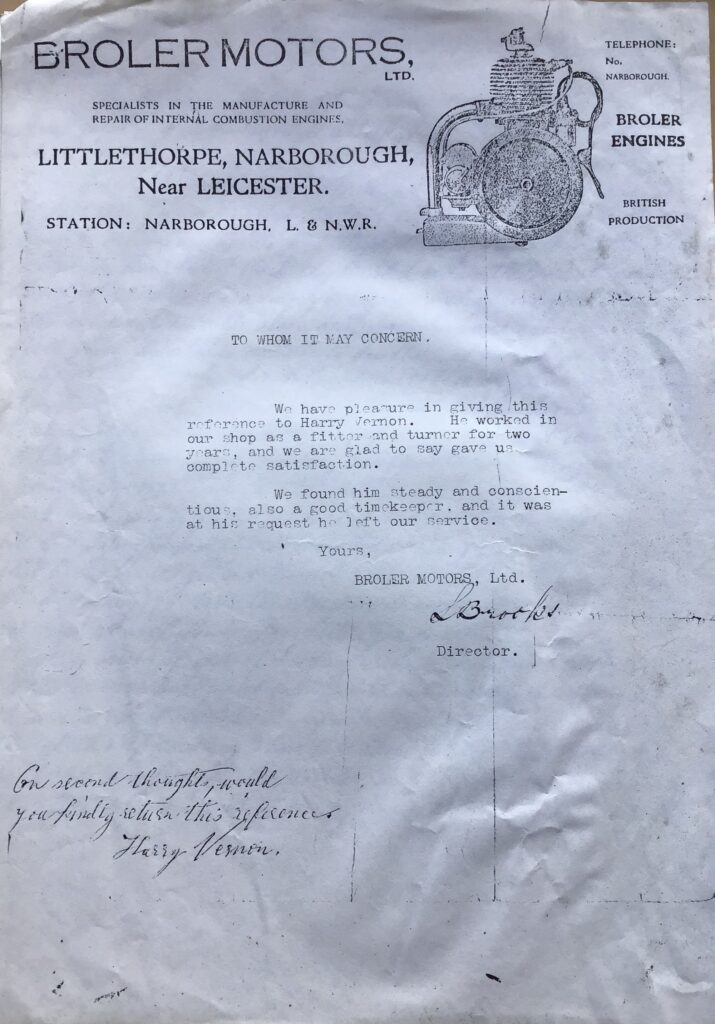
Broler Letterhead and reference for Harry Vernon.
The following is from an extract from Sheldons EMU British Motorcycles
“motorcycle produced from 1920 to 1922. The company of Brooks, Tasler & Cox was based in Narborough (Littlethorpe) Leicestershire. Their slogan was ‘you will never tire a Broler’.
At the beginning of the 1920’s they promoted a 349cc two-stroke engine, which formed the basis of their short-lived motorcycle. The engine was a three-port type but, for ease of running, it featured ball-and-roller bearings throughout.
Broler motorcyles were also marketed as the Spartan and the Welland B.
The firm changed its name to Broler Motors and sold the engine to other companies that assembled machines, including Campion.MPH, TEJ and Vasco. This kept them afloat for a while, until business dried up.”
from The Motorcycle magazine mid-1922
“The Broler 3.1/2 h.p. 2-stroke stands supreme for workmanship and effiency. Unequalled at the price of £10/15 (2025 equivalent value £726/1089), which includes cast aluminium silencer, magneto chain case, chain, and sprockets. FRAME to suit, built of Brampton fittings and 12 and 14 gauge tubing; price complete with frame and tubular carrier. £4/17/6( £360 in 2025); order early for quick delivery. – Broler Motors, Narborough, Leics.”
from The Motorcycle December 1922
“Broler 3.1/2 h.p. 2-stroke engine that can lap Brooklands at 51 mph after 7,000 miles on the road. Important reduction in prices. In order to bring our production within the reach of a greater proportion of the public we are for one month only offering this engine at £9. This price includes aluminium silencer,magneto platform (one-nut chain adjustment), magneto chain and sprockets, cast aluminum chain case (grease tight). Lodge T.S.3. plug, 7/8in. or 3/4in. belt pulley – sprocket 4/- extra. These engines fitted Skefco ball bearings to main shaft, Hoffman rollers to big end. These engines are not a job line, all parts being interchangeable. Write for illustrated catalogue and be convinced. Broler Motors Ltd., Narborough, Leics.”
A company letterhead and employee reference for Harry Vernon (Harry emigrated to Australia from where this was sent in his later years) see photo above.
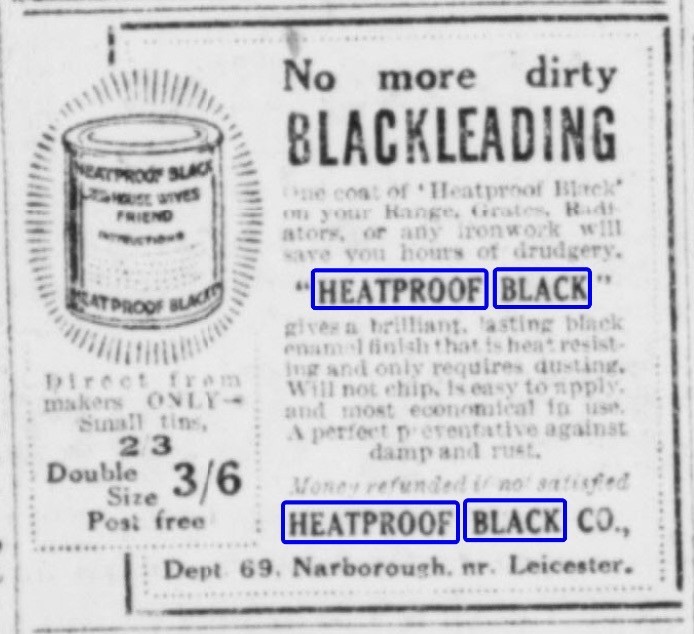
Heatproof Black advert fron The Daily Mail.
On the 2nd October 1953 Melrose Hosiery, manufacturers of ladies nylons were in occupation and advertising for B5 machine operators and a young man to learn hosiery machines. The Leicester Daily Mercury of 26th June 1956 reports yet another fire at the factory which destroys 6000 pairs of nylons. The alarm had been raised by my father Mr E.G.Thompson at 9.45pm the previous evening. The report states the firm having been in business for three years which probably coincides with their above advert for staff. I have a vague recollection of my brother Phillip working there and stoking the heating boiler early hours.
The late 1950’s, probably 58 and certainly 1959 sees The Talbon Engineering company there, they made rotary wire brushes for use with Black & Decker drills and the like and were always known as Talbon Brush. My mum did outwork for them by assembling cardboard boxes for packing the brushes. They moved to new premises in Regent Street Narborough in the early 1960’s.
From C.1962 until about 1966 it was used by Littlethorpe House Farm for storage (did Waudby own it along with the farm? if so and in the ownership of Littlethorpe House, a previous occupant there had been a Mr Dixon, leather merchant, shoe factory theory?) I remember hay bales being loaded into the upper factory floor, produce of the field between no.10 and the river Soar known as Biddles meadow.
In 1966 it was bought by the engineering firm of Looms & Richardson, they extended the factory building to the rear over what was Joe Biddles garden, demolished the stables and barn, erecting a prefabricated single storey concrete building in its place.
I bought the factory in the early 1990’s for use as storage and offices for my then windscreen replacement business.
It has since been converted into a private residence.
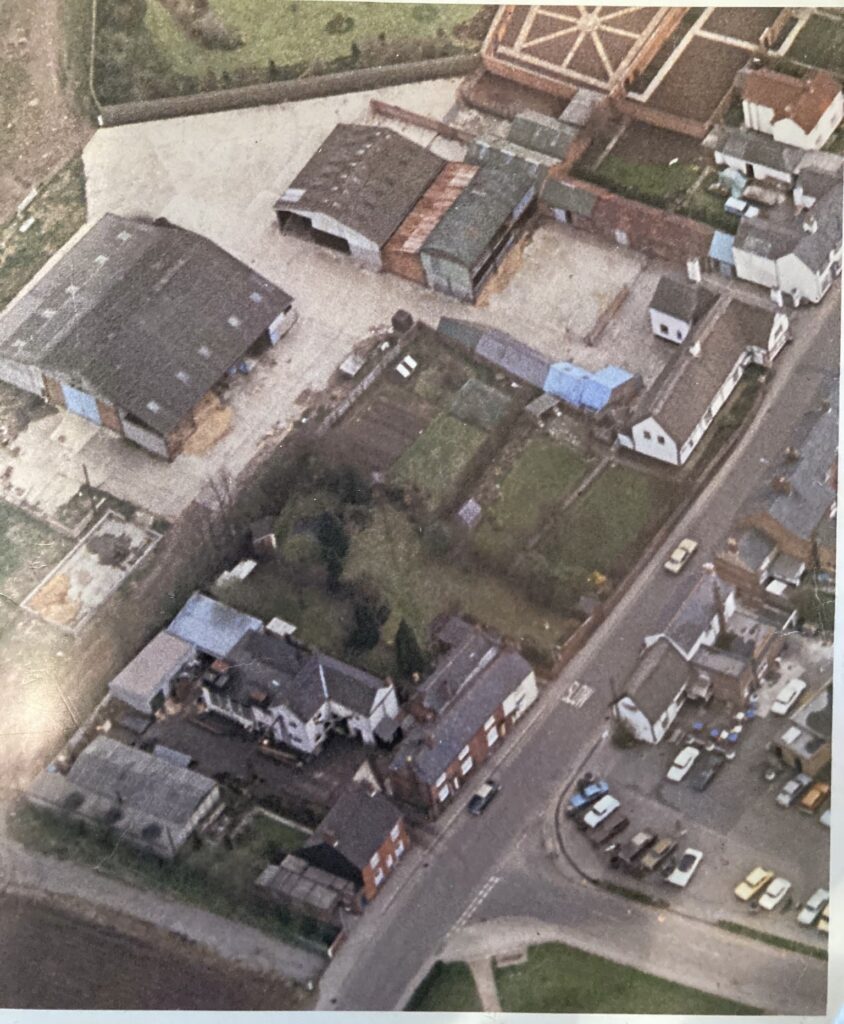
1970’s aerial photo (courtesy of Stephen Durrance) showing factory, farm, The Plough Inn, and No’s 10, 12, 14, and 18 Station Road.
Sources:
As with any local history research continues on this and more information will hopefully be added as it is found, so keep checking for the latest updates. In fact if you can add anything to the above please get in touch via the contact form