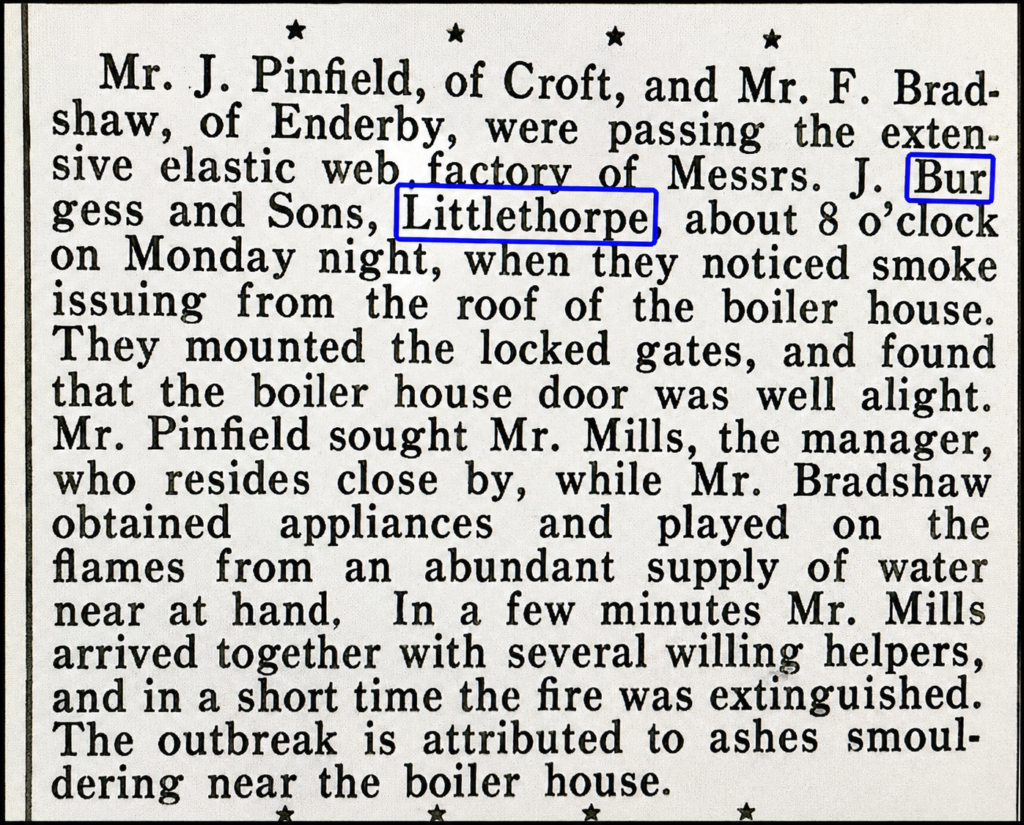
Victoria Mills was situated in Littlethorpe, set back from the corner of Cosby Road and Warwick Road, and just bordering the village boundary with Whetstone parish. An accurate date for the building is difficult to arrive at, we know it was there by 1885 because it shows on the earliest ordnance survey map that we have, published in 1886. We also have evidence from a newspaper report of 1882 (shown below) that it was at least in use by then. 1881/1882 would therefore seem a good build date because no elastic braid workers appear in the 1881 census but the 1891 census mentions several, change was happening in Littlethorpe!
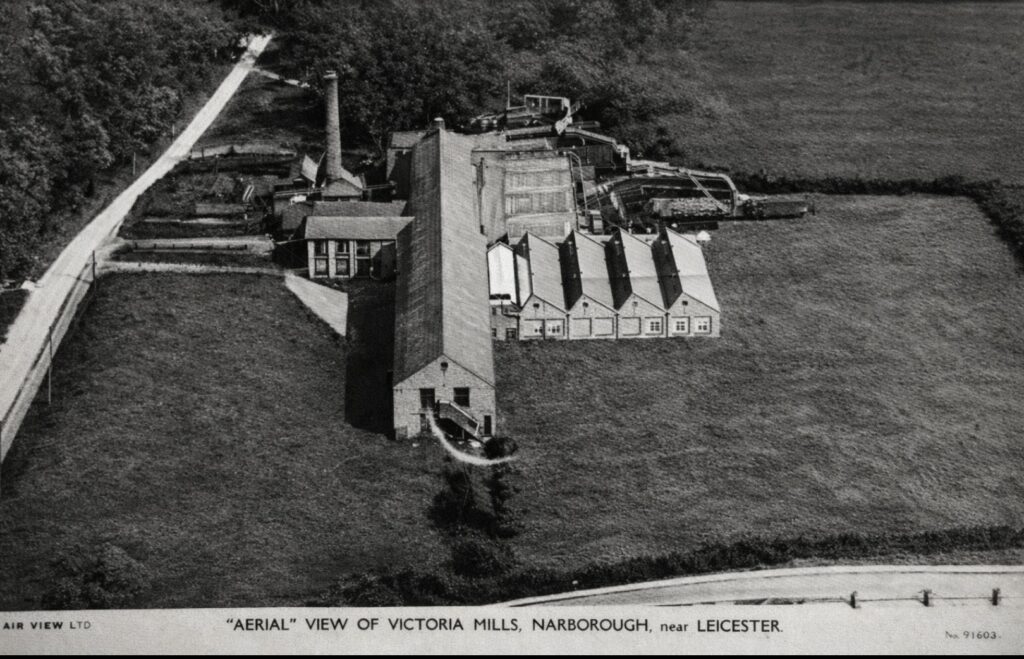
Aerial photo of Victoria Mills situated on Warwick Road, Littlethorpe.
The photograph was kindly provided by Nev Duncan and his wife Rosemary.
An aerial photograph of Victoria Mills shows just how substantial the works had become. The photograph reveals an extensive complex of buildings, together with a prominent factory chimney. It also shows Warwick Road widened down as far as the mill entrance forming a kink in the road.. Notice also the abundance of trees and no houses showing on the left.
It is particularly valuable because by this stage the site was no longer simply a name on a map. The photograph gives us an impression of the scale of the industrial complex and its position within the surrounding countryside.
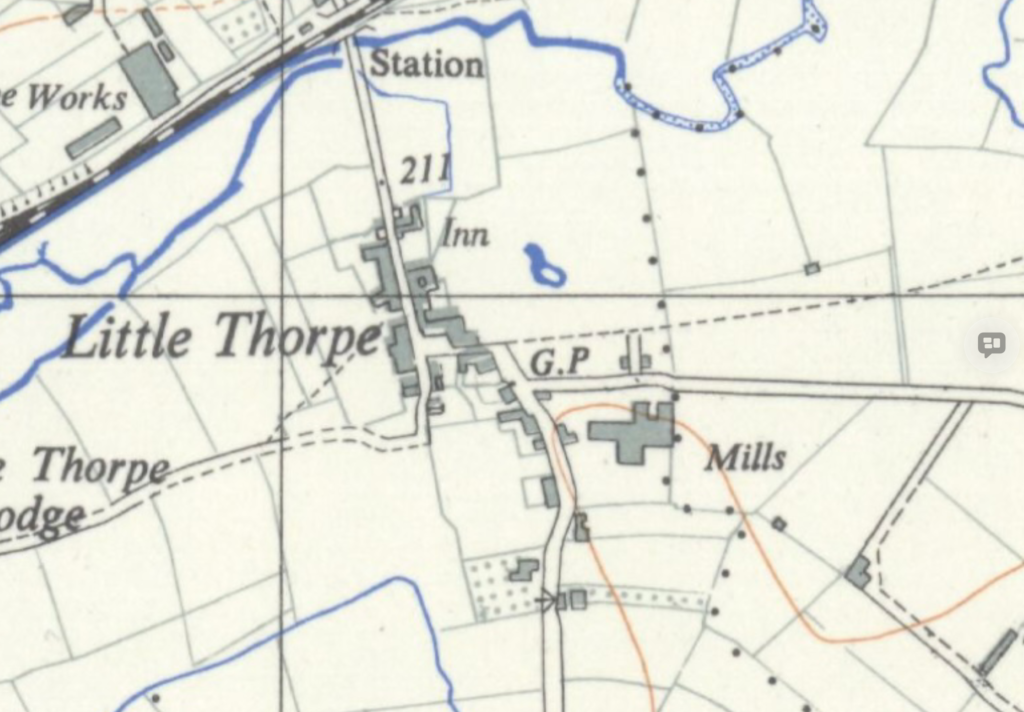
Circa 1921 OS Map showing the footprint and location of Victoria Mills
There is also the Leicester Daily Mercury report dated 3rd May 1882 shown below.
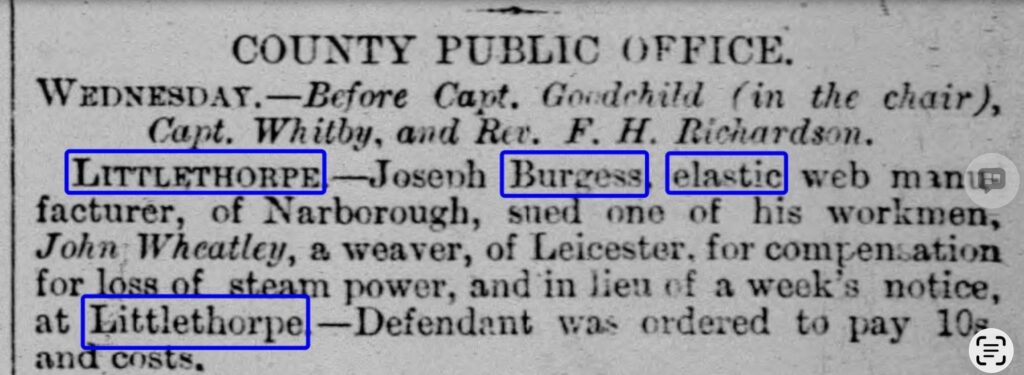
1882 press clipping from The Leicester Daily Mercury dated the 3rd May. Find my Past
Another report from the same paper exactly two years later to the day in 1884 tells us that Burgess had 10,000 spindles at work but lost work due to a strike led by one Thomas Clarke. Clarke was successfully sued by the company for breach of contract between master and servant!
Again from the same paper dated 7th January 1888, Rose Emma Smith of Whetstone and a worker at the factory got her leg caught in the machinery cogs, this was on a Saturday. She taken to the Leicester Royal Infirmary and found to have a compound fracture to her leg. Quite painfull in 1888 I would think!
The staff of Burgess & Co had regular monthly collections amongst the workforce in aid of the “Hospital Saturday” fund, their donations being somewhere between £1 and £6 each month.
The Leicester Daily Post of November 2nd 1909 reports on the formation of Burgess & Co with a capital of £90,000. The report confirms that the previously private company was in the hands of Joseph & Harry Burgess, being formed about forty tears before in C.1869, a few years before having the new factory built at Littlethorpe.
The works were steam powered as evidenced by the tall chimney in the picture above. Presumably John Wheatley referred to in the article above, had some responsibility for looking after the engine or, caused it damage in some way, after leaving without giving notice. He didn’t get away with it though because his employers sued him. This is not the only case I have come across where an employer sues his staff, Burgess does it more than once, also see No.18 Station Road, Littlethorpe, Leicestershire & It’s History
In 1912 The Leicester Evening Mail of March 25th reports on a national coal shortage and the fact that Burgess & Co have an unexpected supply of engine “slack” , enough to keep them going for another fortnight. Coincidently it reports that a Littlethorpe gentleman has a good supply of coal which he will supply to the poorer village residents for 1 shilling (5p) per cwt, cost price.
From The Hinckley Times 10th May 1913
1915 24th May The Leicester Daily Post reports that Burgess & Co, from the first pay day in June will pay their workers a war bonus as follows:- boys & girls up to 16 years of age 6d (2.1/2p), single workers men or women 1s (5p) and married men 2s (10p).
For a village which, well into the nineteenth century, was predominantly agricultural, and where framework knitting was one of the principal occupations, the presence of such an extensive industrial works is particularly interesting and must have caused great interest among the villagers of the time.
1923 20th January The Hinckley Times reports on the funeral of Thomas Mills aged 64, stating that he had managed Burgess & Co for 35 years before retiring due to ill health some time before, this fact, allowing for some years of retirement seems to confirm a likely starting date for Burgess & Co in Littlethorpe of 1882. Mr Mills, an apt name for a mill manager was noted as being a very popular man.
Why was a substantial factory established in what was then little more than a small hamlet? It certainly had an impact particularly noticeable in the late 19th century, and early 20th century census returns which show many village people employed at the factory.
There are several possible explanations, one obvious factor was transport.
The South Leicestershire Railway reached neighbouring Narborough in 1864, giving the district a much improved means of transporting labour, raw materials and finished products. The railway could bring materials close to the works and provide a means of distributing manufactured goods beyond the immediate locality.
It also potentially transformed the labour market. Before the railway, a factory situated in a small rural settlement would have had to rely largely on people living within walking distance. With Narborough station available, the potential catchment area for workers was considerably greater. A case in point is John Wheatley mentioned above who lived in Leicester, just a ten minute train journey and a ten minute walk away.
There was, however, another advantage already present in Littlethorpe and the surrounding villages. Framework knitting was one of the area’s most common occupations. The village therefore already possessed a population familiar with textile manufacture. Although the work carried out at Victoria Mills was different from traditional framework knitting, there was potentially a ready-made pool of people accustomed to working with basic machinery, yarn and textiles. This may have been an important reason why an industrial concern could successfully establish itself in Littlethorpe. Joseph Burgess were already established in Leicester and later at Coalville.
Elastic web was commonly used by the local boot and shoe industry for the elasticated gusset in boots, also used for belts and braces etc. For more information visit here:-https://www.victorianvoices.net/ARTICLES/CFM/CFM1882/CFM1882-Elastic.p
The Littlethorpe works were under the management of Thomas Mills, Thomas lived at what was called “Red House” which seems to have been located in The Square
Another directory specifically records:
Burgess Joseph & Son Ltd — elastic web manufacturers — Littlethorpe, Leicester & Brougham Street, Leicester & Belvoir Road, Coalville, with Thomas Mills as manager.
Elastic web was an important Leicester industry. The city had become a major centre for the manufacture of elastic goods during the nineteenth century, with the material being used for such things as braces, clothing and other products requiring woven elastic.
The Littlethorpe factory therefore connected this small Leicestershire village directly with one of Leicester’s specialist industries.
Whether or not the business took a downturn in trade, or whether the works were expanded we don’t know but from at least 1934 the mills were also occupied by the Gummed Paper Manufacturing Company who were established in 1934.
A surviving letterhead dated 31 December 1934 provides direct evidence of this company operating from Victoria Mills.
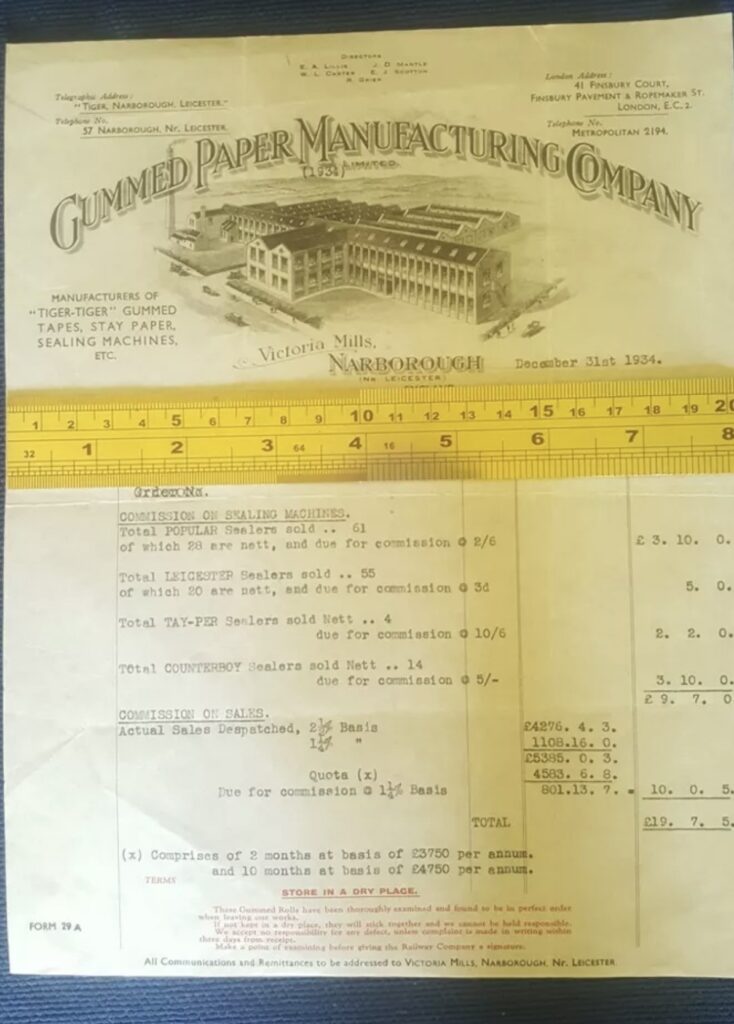
Gummed Paper Manufacturing Company letterhead dated 31st December 1934.
This gives an artists impression of the mills as they were in c.1934. It also describes some of the products like “Leicester Sealers”, “Tiger-Tiger Gummed Tapes” and “Stay Paper Sealing Machines”. It also reveals some interesting sales figures.
People were still employed as “elastic braid hands” at the time of the 1939 register.
1940 24th August, The Leicester Chronicle reports on Leicester companies involved in raising funds to buy a Spitfire fighter plane, cost £5000. The Gummed Paper Company is one of those mentioned as was the other occupant of Victoria Mills, Fine Silk Stockings Ltd, they donated ten guineas (£10.50p). It was hoped the plane would be called St. George.
Victoria Mills and the growth of Littlethorpe
Historic maps provide an interesting picture of the relationship between the mill and the village.
In 1886 Littlethorpe was still essentially a small linear settlement. Between 1886 and 1938 there was relatively little expansion along Cosby Road, yet development did take place around Victoria Mills.
This suggests that the mill was an important influence on the physical development of the village.
It also raises an interesting question:- Did people move into Littlethorpe because employment was available at Victoria Mills, or did the factory primarily employ people from the surrounding villages?
By 1943 Burgess & Sons seems to be no more, their place being taken by the Fine Silk Stocking Manufacturing Co.Ltd.
The end of Victoria Mills came one night during the Second World War. Nev Duncan, who was a boy at the time remembers staying overnight at his grandfathers house on Cosby Road situated directly opposite the mills when they were destroyed by fire on Good Friday night, 23 April 1943
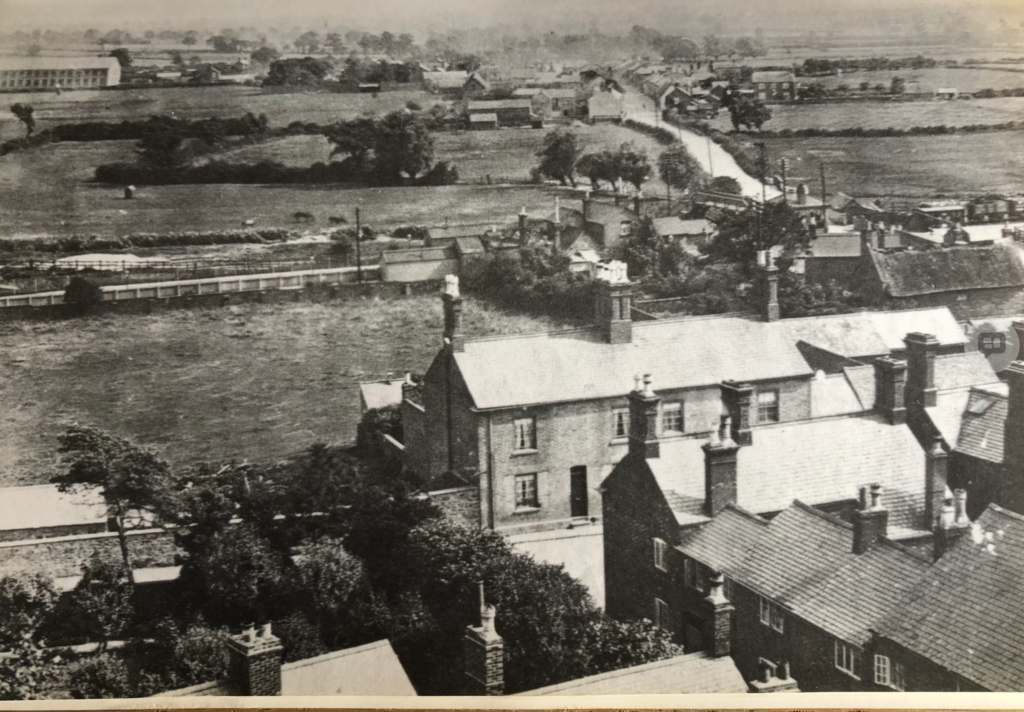
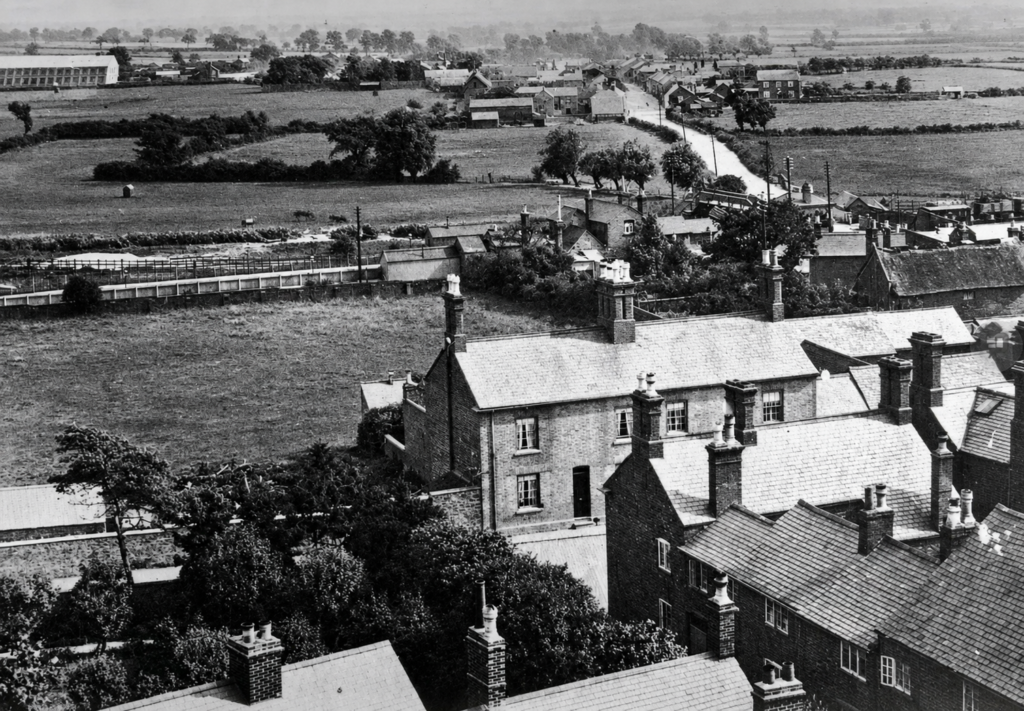
This photograph taken from the top of Narborough Church tower shows Victoria Mills in the top left hand corner, and also much of the village as it was pre-war.
1943 24th April and The Leicester Evening Mail carries the first report of the fire and shows the destruction caused.
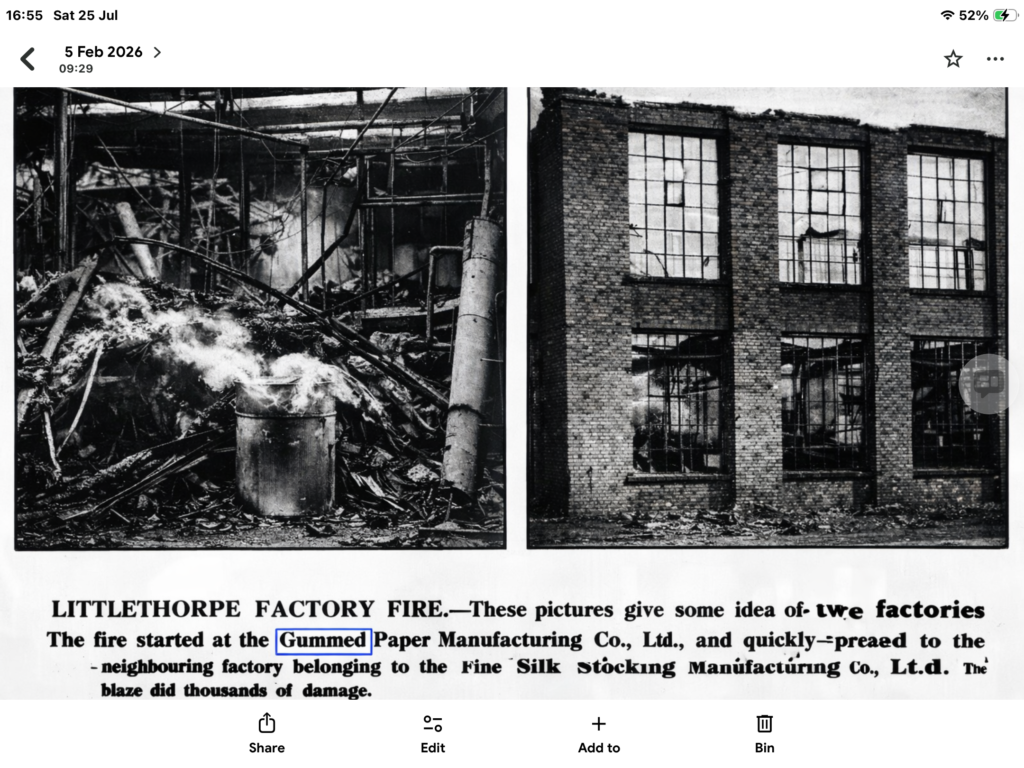
The aftermath of the 1943 fire showing total devastation.
What happened afterwards?
Did all the employees lose their jobs? how did they manage? it must have had a devastating effect on the village as a whole. Nev Duncan remembers his uncle Hubert Bingley demolishing the factory chimney when the site was cleared.
The site was later home to the Blaby Rural District Council depot. Now replaced by Thorpe Gardens and Goodman Close.
Sources: Nev & Rosemary Duncan, Find My Past,
As with any local history, research continues on this and more information will hopefully be added as it is found, so keep checking for the latest updates. In fact if you can add anything to the above please get in touch via the contact form. I am always happy to be updated or if necessary corrected. I’m totally human and not an AI bot so errors can be expected from time to time.