This remarkable document offers a vivid insight into one of Littlethorpe’s more successful framework knitters at the turn of the 19th century. Although his exact birth date remains uncertain—likely around 1750—we know that James Bingley died on 30th May 1810 and was buried just two days later at Narborough. What survives in his will is not only a record of his death, but a detailed testament to a life of industry, property ownership, and careful provision for his family.
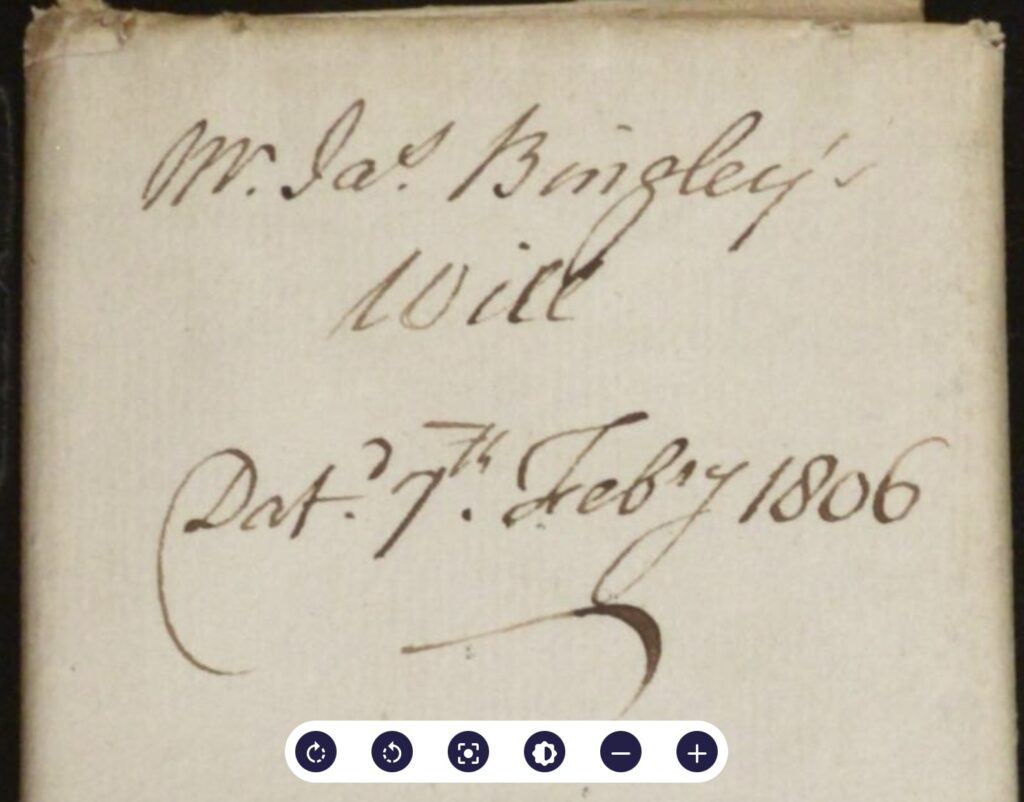
His will establishes him as more than a typical labouring framework knitter. By the time of his death, he had accumulated a portfolio of property and productive assets.
His bequests include multiple dwelling houses in Littlethorpe, specifically those occupied by David Jarvis and John Hill, situated near Narborough Lane (known today as Station Road). In addition, he owned the dwelling house and garden of Reuben Jeay, together with two nearby framework knitters’ shops—clear evidence of his direct involvement in, and profit from, the hosiery trade.
The mention of these workshops is particularly significant. Framework knitting was often organised on a domestic or small-scale workshop basis, and ownership of multiple frames and premises suggests that Bingley operated not just as a worker, but as an employer or small-scale industrialist within the village economy.
The will goes further, describing adjoining land to the rear of these properties—formerly known as Jewells Close —along with an additional close of ground lying behind. This land included shared access to a well and is described in striking detail, with boundaries, fences etc., measured precisely in yards, feet, and inches.
References to pigsties, posts, fences, and closes help to bring it all to life. This is working property and environment: one that combined domestic living, small-scale industry, and agricultural use. Such precision also reflects the importance of clearly defined boundaries in an era when disputes over land could be common and costly.
His estate was not simply divided—the bulk of his Littlethorpe property, including these houses, workshops, and land, was bequeathed to his son James (born c.1788). However, this inheritance was subject to a life interest: Bingley’s widow, Ann, was to retain use of his own house, yard, and garden for the duration of her widowhood.
This arrangement ensured both security for his wife and continuity for his son, preserving the estate intact rather than fragmenting it prematurely.
His second son, John Thomas—baptised at Narborough on 10th April 1791—was also provided for, receiving his share upon reaching the age of 21. This delayed inheritance reflects a common practice, ensuring maturity and, perhaps, readiness to manage property or trade.
One of the most striking elements of the will is the bequest to his grandson, John Bingley (baptised 21st January 1805 at Narborough): no fewer than 23 stocking frames of 18-inch width.
This is a powerful indicator of wealth. Stocking frames were valuable pieces of equipment, central to the hosiery trade, and ownership of such a quantity places Bingley well above subsistence level. These frames represented both capital and income—tools that could generate livelihood for the next generation.
In addition, his remaining five stocking frames, along with household goods and furniture, were left to his widow Ann, on the condition that she remained unmarried. This clause—“as long as she remains such”—was typical of the time, designed to ensure that assets remained within the Bingley family rather than passing to a future husband.
His concern for order is further reflected in his request that his nephew, Thomas Bingley, and his friend John Wale of Aylestone assist his widow in taking an inventory of his personal estate and effects. This was a prudent measure, ensuring transparency and proper administration, particularly given the scale and variety of his assets.
Probate was granted with an estate valued at under £200—equivalent to just over £10,000 today. While this may appear modest by modern standards, the detailed nature of his holdings—multiple properties, workshops, and nearly 30 stocking frames—reveals a man of considerable local means and influence.
James Bingley’s will paints the portrait of a man who had successfully navigated the opportunities of a changing rural economy. Through industry, property acquisition, and careful planning, he established not only a livelihood but a legacy.
His bequests reflect both affection and strategy: provision for his widow, structured inheritance for his sons, and a substantial industrial foundation for his grandson. In doing so, he ensured that the fruits of his labour—houses, land, and frames—would continue to support the Bingley family for years to come.
In this single document, we see the intersection of trade, land, and family—a life rooted in Littlethorpe, measured in yards and inches, and secured through foresight and care.
So once again open to further research and updates.
Sources:
As with any local history research continues on this and more information will hopefully be added as it is found, so keep checking for the latest updates. In fact if you can add anything to the above please get in touch via the contact form