I recently had the pleasure of meeting Nev Duncan and his wife Rosemary. Nev was born in the village before the war and has lived in the area all of his life, his recall of people, places, and events is truly remarkable. Over the coming weeks, and probably months! I shall be sharing what I’ve learnt.
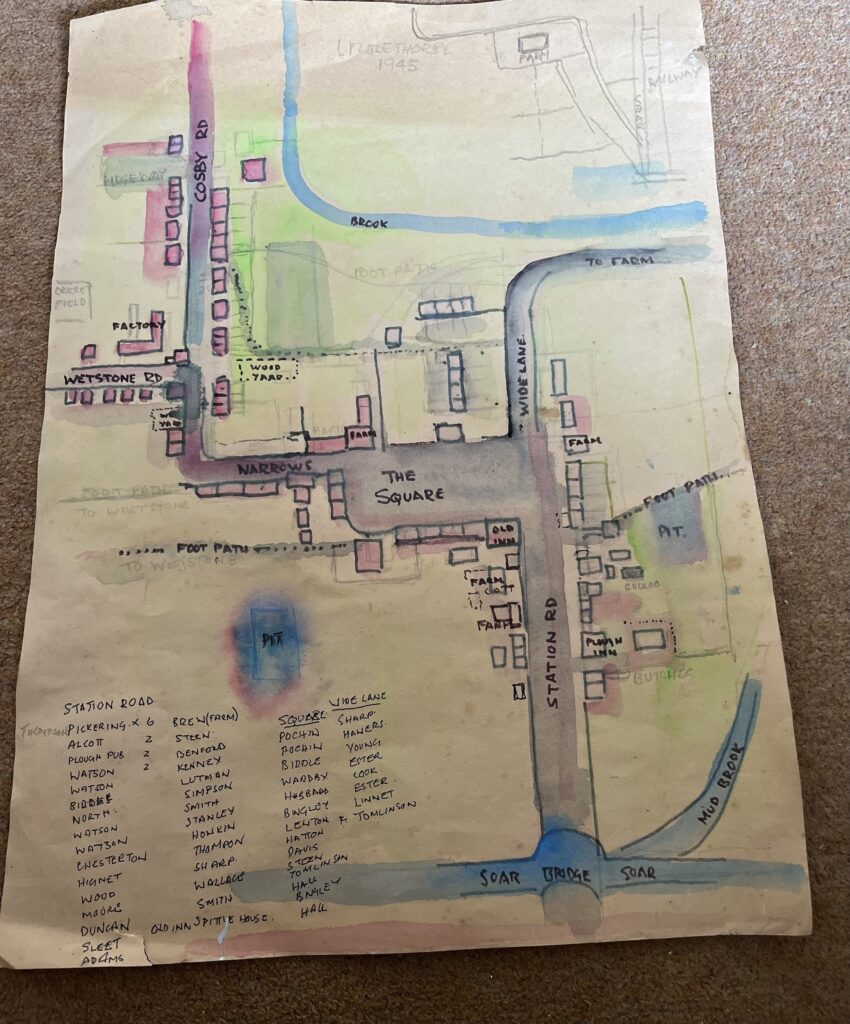
Nevs Map of Littlethorpe in the 1950’s
Overview
This account records a wide-ranging oral history shared by Nev and Rosemary Duncan, reflecting on families, buildings, work, and everyday life in Littlethorpe and Narborough across the late 19th and 20th centuries. The memories span farms, pubs, shops, factories, transport businesses, and housing developments—many of which have since disappeared or been altered beyond recognition.
The narrative is rooted in lived experience and family memory, particularly connected with the Bingley family and their role as builders, farmers, publicans, and tradespeople, alongside recollections of many other long-established local families.
Early Homes and the Pickerings (c. 1940s)
The Pickerings moved into 10 Station Road Littlethorpe shortly after the Second World War, around 1948. Before this, they lived in an old thatched pub in Huncote, located just beyond the Red Lion. The pub stood among a small group of thatched cottages and was later demolished; the site is now part of the Red Lion car park.
Mr Pickering worked in local stone and quarrying industries. When the pub was condemned and pulled down, the family relocated to Littlethorpe. Their children grew up locally before the family later moved nearer to Narborough village centre.
Industry, Workshops, and the Woodyard
Station Road and nearby areas once supported a range of small industries, including sawmills, workshops, and factories. Although little remains today, these sites provided employment and shaped the character of the village.
A prominent local building family developed woodyards, workshops, and housing in Littlethorpe, Narborough, and Cosby. Their operations included wheelwrighting, timber work, and speculative house building, much of which has now disappeared.
Pubs, Inns, and Social Life
Littlethorpe and Narborough once supported several pubs within a very small area. These included long-established inns, smaller beer houses, and short-lived pubs remembered only through family recollection.
One pub remained central to village life for generations, with links to brewing, grazing, and malting. Timber beams inside still bear family names carved over decades. Another small thatched pub on a corner was remembered for its simplicity—bench seating, a single bar room, and a local nickname that reflected its size and character.
There are also memories of a possible fourth pub, known only by name in family recollections, whose exact location has never been identified.
Builders, Houses, and Lost Buildings
Much of Littlethorpe’s early 20th-century housing was constructed by local builders working weekends and evenings, often on land they had saved to purchase themselves. Pairs of houses, small terraces, and detached homes were built steadily from the 1910s through the 1950s.
Many older cottages, farm buildings, and yards were later demolished or absorbed into newer developments. Some houses were reduced in height or rebuilt entirely, while others retain earlier features hidden behind later alterations.
A recurring theme is regret at the loss of handwritten building records and account books, which once documented where houses were built, who lived in them, and how much work cost.
Farms, Fields, and the Changing Landscape
The surrounding fields once supported dairy farms, grazing land, market gardens, osier beds, and allotments. Footpaths crossed the fields linking villages long before modern roads dominated travel.
Some farms were rented rather than owned, passing through multiple hands over time. Others were gradually broken up for housing after the war. Names such as “The Ridgeway,” “Spring Gardens,” and older field names survive even where the land use has completely changed.
Wartime and Post-War Life
The Second World War features strongly in memory: factory fires, troop movements, food production, and social change. After the war, housing demand increased rapidly, leading to new bungalows, council houses, and private developments.
Transport businesses, haulage firms, and bus operators expanded during this period, supporting local industries and quarries. Vehicles, drivers, and depots became familiar sights in village life.
Family Memory and Community Life
The account preserves many small but important details of everyday life: nicknames used locally, childhood games, village cricket, walking routes, shopkeepers, craftsmen, and neighbours. It also records more difficult moments—illness, sudden deaths, family disagreements, and missed inheritances—handled here with discretion.
These memories collectively show how closely connected families were, how work and home life overlapped, and how rapidly villages changed within a single lifetime.
Editorial Note
This transcript has been lightly edited for clarity and lightly anonymised to protect the privacy of living individuals. Names of deceased persons, historic buildings, and places have been retained where historically relevant. No factual content has been knowingly altered.
Credits
- Interviewees: Nev and Rosemary Duncan
- Recorder / Compiler/ Copyright : Dave Thompson ; Nev & Rosemary Duncan
- Date: 28 January 2026
- Location: Littlethorpe & Narborough, Leicestershire