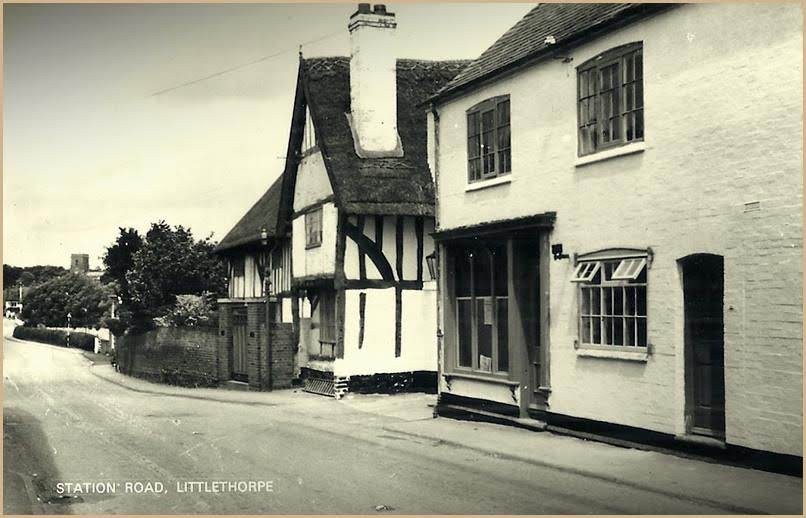
A walk up Station Road — known as Narborough Lane before the arrival of the railway — beginning at Narborough station and following the houses in numerical order as they appeared in the 1939 Register.
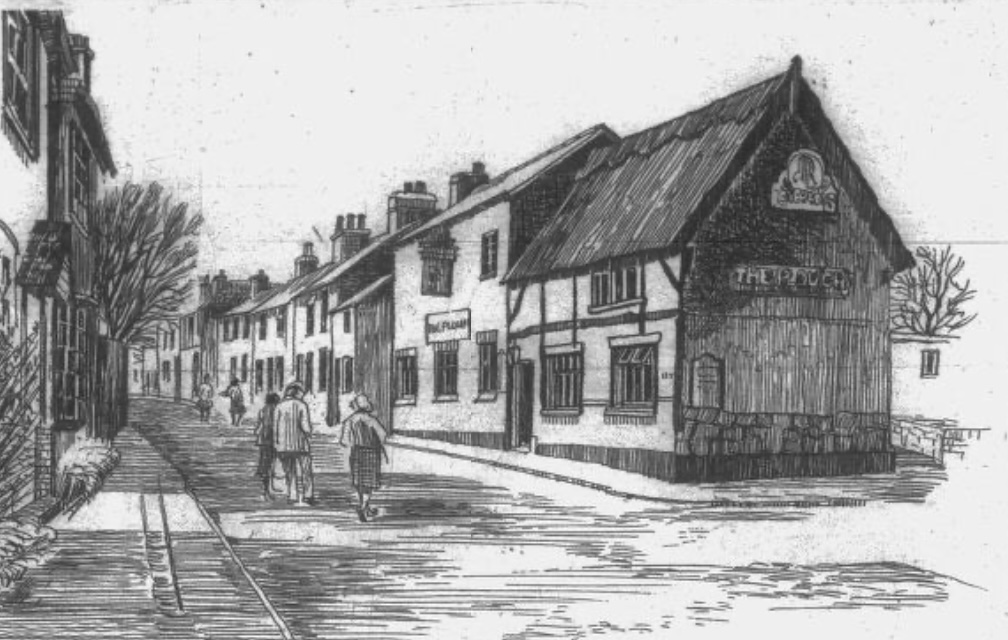
Pencil sketch of Station Road & The Plough Inn
Before that time, houses were not numbered in any of the census reports . A small number had names, but more often properties were identified simply by the name of the occupier. A letter might be addressed to A. Bingley, Littlethorpe (Bingley being one of the principal village surnames), or you would just ask in the village itself — everyone knew everyone, and they knew exactly where each person lived.
All of this means that accurately pinpointing individuals to specific properties prior to 1939 requires a certain amount of detective work. The further back we go, the more gaps there are to fill.
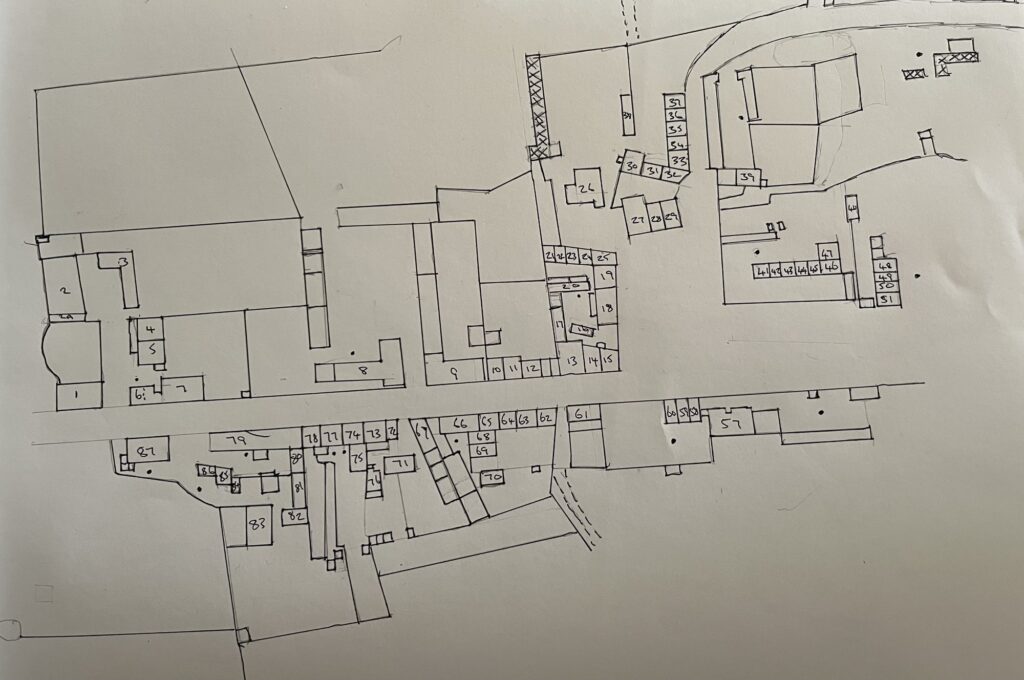
Map key of 1939 Station Road house numbering.
Drawn using the 1886 Ordnance Survey map as reference, as there was little change in the properties between the two dates.
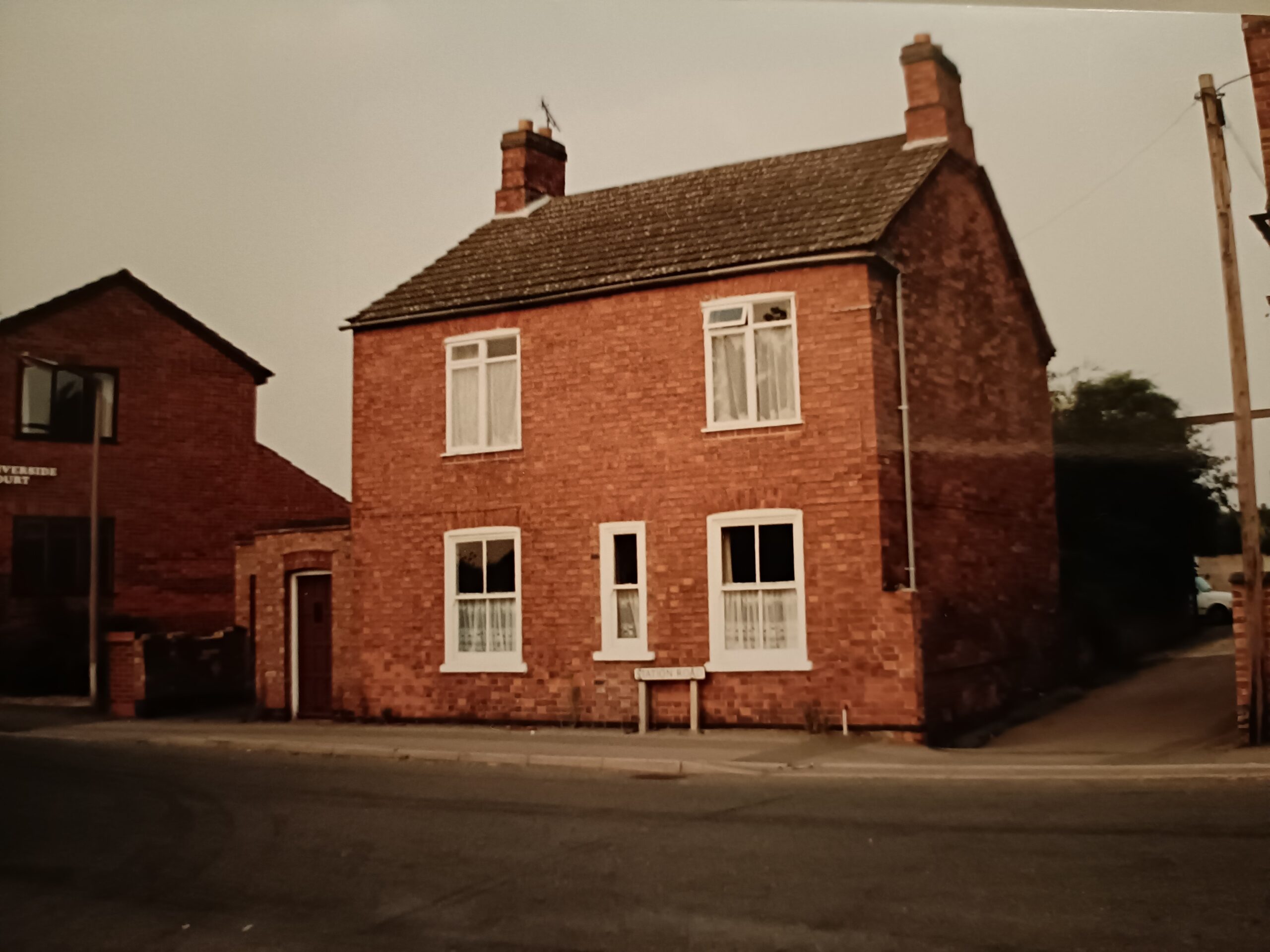
First on the left is 10 Station Road, built c.1790–1830 and re-fronted in the early 20th century. This was our family home — the Thompsons — from 1951 to 1988. Before us came the Pickerings, who moved there in 1948 from the old, now-demolished Barley Sheaf pub in Huncote. The Spiers family are recorded at the property by at least 1911 and possibly remained until 1948.
In 1891 the occupier appears to have been Herbert Rowell, a quarry manager. In 1881 it was almost certainly George Gray, a fellmonger. Anne Pratt, a landowner of 17 acres, is recorded there in 1861 and possibly 1871.
Between No’s 10 and 12 a double-gated entrance led to a cobbled yard with Factory, and Brick Barn & Stables to the rear. Over the years, a remarkable variety of products were manufactured at the factory, including motorcycle engines, black lead grate polish, ladies’ nylons, wire brushes and various engineered items.
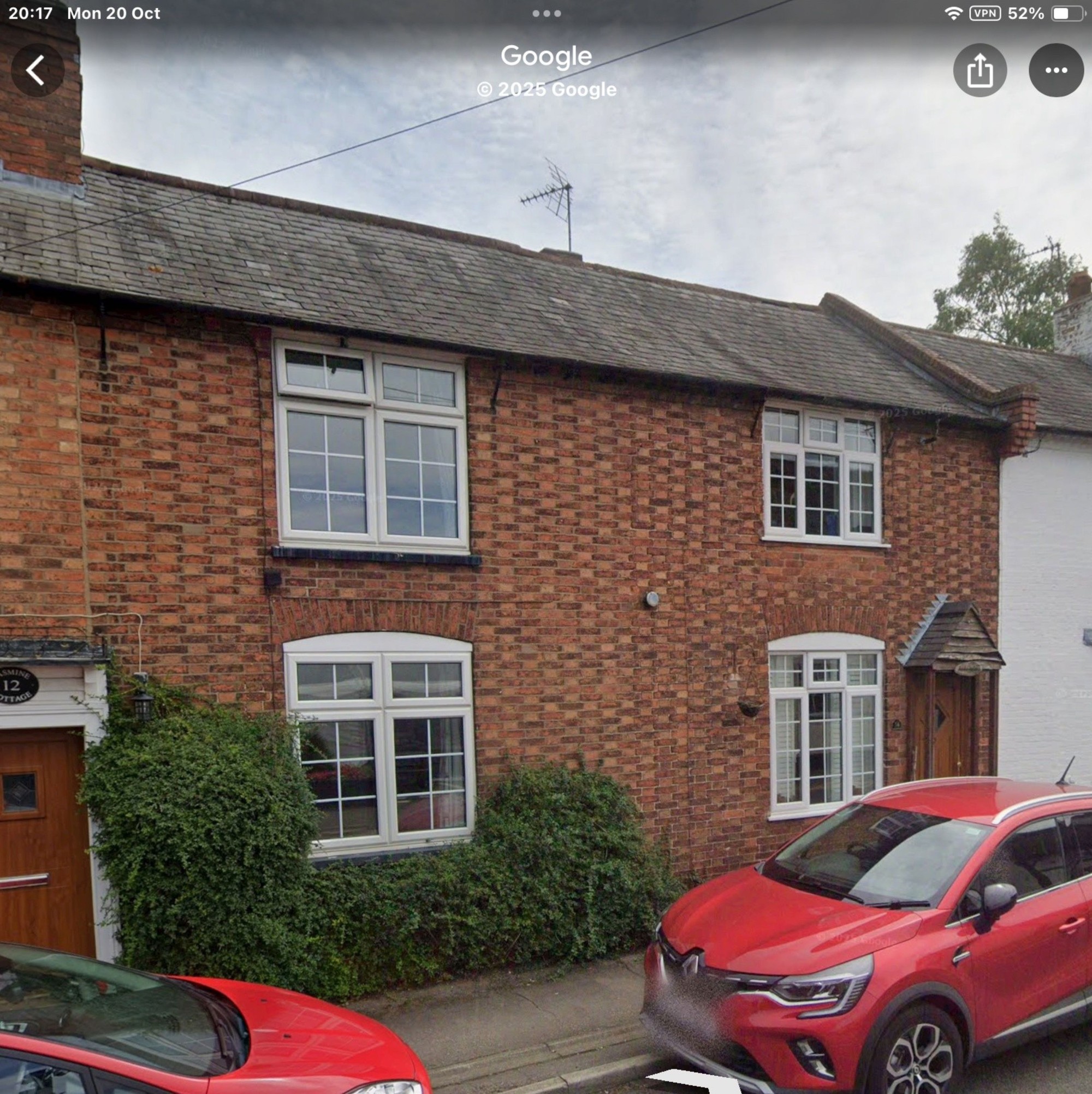
12 Station Road, dating from c.1880, was created by extending No.14 — the change in brickwork is still plainly visible. The Biddle family carried out the alteration and retained ownership until 1962, when it was sold to Mildred Couling, a former matron at Carlton Hayes Hospital and district nurse.
Her granddaughter June shared this amusing story:
“We had a telephone put in for her as she got older, but she wouldn’t answer it because she didn’t know who was ringing — so she hopped on her bike and went to the phone box (opposite Turner’s) to ring us to see if we had called her!”
14 Station Road, built c.1860 and distinguished by its chequer brickwork, was converted into two cottages in the late 1950s. Mrs Irene McReynolds and her son Sean purchased the first; David and Ann Evans bought the second, renumbered 14A.
Prior to conversion, the property was home to the North family, who had farmed next door at Old House Farm from the 1860s. In front of Nos. 12 and 14 once stood a row of iron railings along the roadside, removed during the Second World War as part of the national scrap metal drive.
16 Station Road/Old House Farm dating from c.1560, is the oldest continually inhabited house in the village. Formerly known as Old House Farm, it was purchased in 1946 by John Walter Waudby (1907 – 1968) of Littlethorpe House, after which it became known as Littlethorpe House Farm.
Roland Durrance arrived as farm manager in 1957, preceded by farm foreman Mr Holtham. Before the 1946 sale, Danny Brew was recorded there in 1939, and possibly there from 1928 after the Norths.
The longest recorded tenants were the North family, originally from Countesthorpe, who farmed there from 1860 to 1928. Their predecessor was Thomas Billson (1786 – 1859). In 1841 the farm was run by 80-year-old farm bailiff Joseph Gamble, likely on behalf of the owner John Hobill, who had by then taken on the water mill at nearby Huncote and was instrumental in opening the granite quarry there.
A double-gated entrance led into the farmyard.
18 Station Road built c.1780, was the premises of Adams the plumbers. Alfred Adams arrived from Somerset in 1863, having taken over the business from John Ashton, who had been there since at least the 1841 census. Alfred built a successful enterprise, at one time employing as many as ten men. A photograph survives showing a very typical and original Victorian shopfront.
Next door to No.18 — and shown on the earliest detailed Ordnance Survey map of 1886 — stood two or three cottages, the first of which was a butcher’s shop. Before their demolition in the 1930s, the butchers were the Lords from nearby Narborough.
After demolition, what became No. 20 was built set back behind a wall, though the granite footings of the earlier properties remain clearly visible. In 1939 the resident appears to have been Elizabeth Heave, a laundress. Later, in the 1950s, Dennis and Rita Marples lived there. Dennis worked for the Waudbys at the farm before taking on the tenancy of the Old Inn in 1968.
Next to No.20 stands a gable end facing the road, now incorporated into The Old Inn. Before that, it was a carriage shed with access from Station Road and from the inn yard. The original pub entrance was beside this — now bricked up, though the alteration can still be seen.
Now let us go diagonally across The Square and begin our walk back down Station Road from No.49.
The terrace comprising Nos. 49, 47 and 45 Station Road does not appear on the 1886 Ordnance Survey map, suggesting it was built sometime between c.1890 and 1900.
In the 1950s No. 49 was the home of the Harrison family. Their son Derek Harrison was a talented footballer who went on to play professionally for Leicester City, later moving to Torquay United and Colchester. In the 1939 Register, the occupant was Florence ——, born 1872, a widow.
At No. 47 lived the Wallace family, who had succeeded George Matthews, born 1882, a carpenter’s labourer recorded there in 1939.
No. 45 was the home of Mac Sharp, who ran the adjacent garage on the corner, later known as The Mechanical Workshop. In 1939 the house was occupied by John Handley, born 1879, who worked at Empire Stone as a cast-stone finisher.
There was no No. 43. This site became the garage premises shortly after the war in the late 1940s. Previously it had been known as the Foal (or Fold) Yard, a compound for young horses owned by Henry Bingley (1900–1971). Before that the ancient cob-walled Littlethorpe Chapel stood here, shown on both the 1886 and 1914 Ordnance Survey maps, but demolished sometime during the 1920s.
We now reach The Cuckoo, from where a short walk leads to No. 41, Cuckoo Cottage, on the right. Beyond this point a footpath crosses fields known as Cuckoo, Rittins Meadow, and Big Cuckoo, eventually reaching Littlethorpe Lodge Farm.
Cuckoo Cottage dates from around c.1790. In the 1950s it was occupied by Brian and Joan Pickering. Joan also kept the village shop at 25 Station Road on behalf of her father, Cyril Bingley. Before the Pickerings, the Duncan family lived here before moving to 23 Station Road, Primrose House. The cottage originally belonged to the Sharpe family, parents of Mabel Duncan.
Returning to Station Road, we find a group of three terraced houses dating from about 1905. These were built by the village builder Abraham Bingley, replacing earlier cottages he had demolished on the site.
As the house numbering has altered over time, it is easier to describe their position, and I have also included the numbers assigned on the accompanying plan.
The corner house (No. 62 on the plan) was occupied in 1939 by Harriet Thompson, born 1879.
Next door, the middle house (No. 63), was occupied in 1939 by Arthur Kenney, who later took over the in 1947. Vernon Panter was living there during the 1950s.
The last of the three (No. 64) was home in 1939 to Herbert Timpson, a capstan lathe operator.
Beyond these stands a pair of typical mid-19th-century Leicestershire red-brick cottages. In the first lived Harriet Welford, born 1876, a widow. Between her cottage and the shop at No. 25 lived Horace Buzzard, born 1874, who was still resident there in the 1950s.
25 Station Road – dates from the mid-19th century. At one time the village shop.
23 Station Road, Primrose House was built in 1886 and first occupied by Henry Breward. (Click link for more)
Between No’s 23 & 21 set back stood The Littlethorpe Bakehouse
No. 21 (No. 72 on the plan) originally served as a flour store for the bakehouse behind. In 1939 it was occupied by William Moore, who remained there into the 1950s.
No. 19 (No. 76 on the plan) stood to the rear and side of the bakehouse. Philip Spittlehouse retired here after serving as mine host at The Old Inn.
At No. 17 lived the Chesterton family, recorded there in the 1939 Register and still present in the 1950s before moving to Narborough to become caretakers at the Robjohn Hall.
At No. 15, the 1939 Register lists Henry Watson, born 1876, and his wife Emma, born 1872. Henry worked as a slaughterhouse labourer. The Watson family originated from Easenhall in Warwickshire, The first one in the village was John Watson (1794 – 1876) he was at 5 Station Road at the time of the tithe apportionments in 1853.
At No. 13 lived Elizabeth Judd, born 1867, together with her son Joseph Judd, born 1892, who was a grazier.
At No. 11, Helena Lambert, a widow, was recorded in 1939 working in the boot and shoe trade.
At No. 9, George Bradshaw, born 1909, was employed as a male nurse, presumably at Carlton Hayes Hospital, while his wife worked at the Gummed Paper Company at Victoria Mills.
Nearby was the entrance to The Plough Inn yard. Here once stood a three-storey malthouse, and possibly a small brewery supplying the pub, likely owned by Robert Bingley. The building had been demolished well before living memory, probably during the 1920s or 1930s.
No. 7 – The Plough Inn
5 Station Road Mary Watson 1939, and the Busby family in the 1950’s.
3 Station Road demolished mid 1960’s for Sycamore Way. John Alcott (1865 – 1960) 1950’s.
All of the above is very much still being researched. It will be updated as the research continues, meanwhile all pre-1968 memories, photos, clippings, research, you name it are welcomed. Keep returning for updates.
All of the above is very much still being researched. It will be updated as the research continues, meanwhile all pre-1968 memories, photos, clippings, research, you name it are welcomed. Keep returning for updates.
Sources:
As with any local history research continues on this and more information will hopefully be added as it is found, so keep checking for the latest updates. In fact if you can add anything to the above please get in touch via the contact form