A single storey brick building with thatched roof, set back behind a cobbled yard, and situated between no’s 21 & 23 Station Road. Entrance to the yard was by a pair of substantial tall wooden gates. In front of the bakehouse itself stood a small brick built flour store.
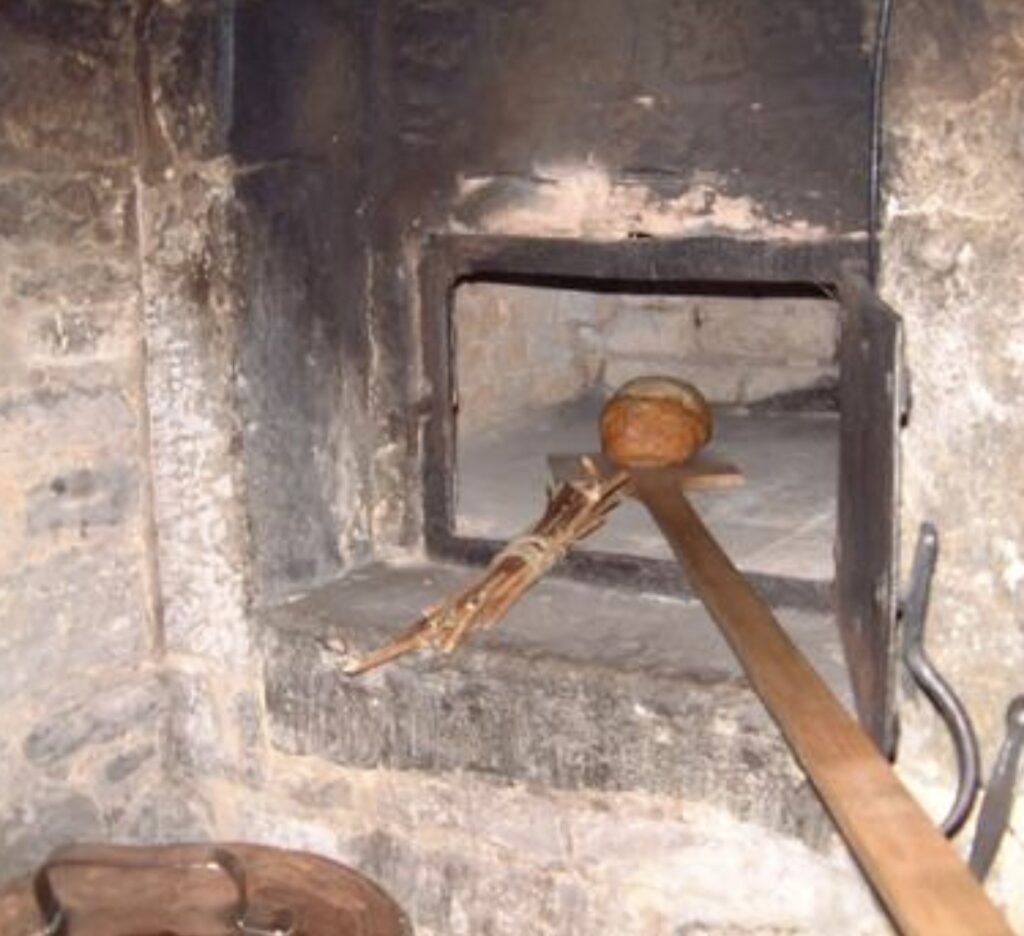
A typical bakehouse oven.
The large bread ovens which were lined with heavy blocks of granite, still existed at the time of its demolition in about 1949, they were disposed of in the now disused well at the back of the adjacent 23 Station Road, Primrose House built in 1886. Also to the rear of No. 23 was a cart shed, for the horse drawn bakers cart (still there at the time of demolition) and a stable for the horse. The stable floor was of red tiles or brick with a gulley for drainage. Water would have come from the hand pump in the yard.
No doubt Sunday mornings outside the bakehouse would see a queue of villagers with their Sunday joints ready for roasting in the oven, awaiting their collection after the church or chapel morning service.
Sadly, the only known photograph of the bakehouse was loaned for a local exhibition and never returned, so a date has to be guessed at, which, probably from the description provided by Nev Duncan was circa mid to late 18th century.
Ownership and Early Trade
The bakehouse and the plot later occupied by No. 23 (Primrose House) was owned by William Jarvis. The Leicester Mercury of 29 January 1880 advertised:
“To let old established bakery business, for many years carried on by Mrs Jarvis, now deceased.”
The earliest recorded baker in Littlethorpe appears in the 1855 Post Office Directory: Joseph Sparrow (b. 1816), who was also a farmer and kept the The Woodboy Inn. He is listed again in the 1861 census. He also makes an appearance here 18 Station Road!
Subsequent census and press records reveal a succession of bakers:
- 1871 – Edward Smee
- 1881 – Robert Forryan (employing one man)
- Thomas Tebbutt and Joseph Sparrow are both recorded as bakers during this period, Sparrow continuing independently from other premises, possibly The long lost Woodboy Inn).
The Leicester Chronicle (11 May 1889) reports the bankruptcy of John Cheney, baker of Littlethorpe. His liabilities were £327 11s 7d (2026 equivalent £5500) with assets of £67 10s 7d. Formerly in business in Cedar Road, Leicester, he had taken over the Littlethorpe bakery after Mr Forryan’s failure in 1885. By the time he arrived, however, many customers had already been secured by competitors. The business was reportedly beginning to recover when he was “pulled up”.
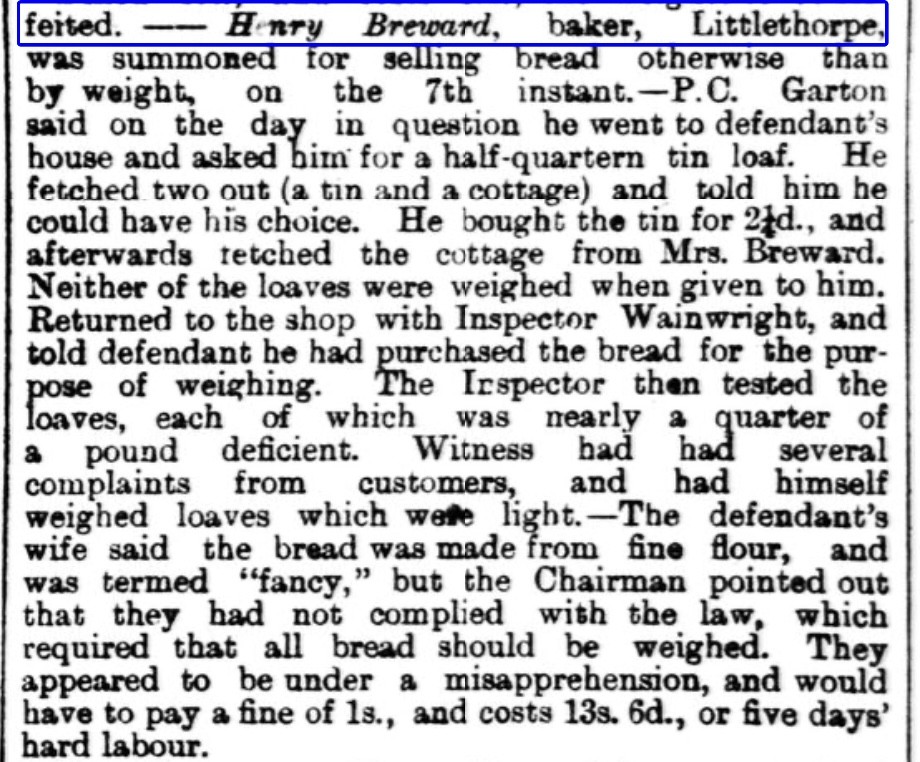
Henry Breward summoned for selling underweight bread
The Primrose House Period
By 1891, we have Henry Breward (he also brewed and sold beer from here) — we know he is the first owner of 5-year old No. 23. Godfrey Jones is living conveniently on the opposite side of the bakehouse lower down Station Road, both describe themselves as bakers. It would appear then that the bakery was a joint enterprise between the two neighbours. An 18-year-old Albert Cooke from the village is also listed as a baker and possibly employed there. The Leicester Chronicle dated 18th June 1887 tells us that Henry was summoned for selling bread otherwise than by weight. See clipping left.
In 1901, Elizabeth Willey appears now as a baker at the adjacent property, previously occupied by Godfrey Jones. At the same time, Arthur Green (b. 1856) is recorded as a baker at the shop 25 Station Road — is he involved or simply selling bread from his grocers shop.
By 1911, Elizabeth Willey is now the occupier at No. 23 and still working as a baker. Next door, in her old property is William Hall (aged 41), and yes you’ve guessed it, he’s a baker!
However, by the 1921 census no bakers are listed in the village. In the 1939 Register, only James Allison (aged 23) appears as an assistant baker of bread and cakes, likely employed elsewhere.
Decline and Closure
Did baking at Station Road cease around the time of the First World War? Financial difficulties during Elizabeth Willey’s tenure at Primrose House suggest the business was struggling. The arrival of the railway — and, more significantly, motorised transport supplying village shops from larger bakeries — may well have undermined the viability of the traditional village bakehouse.
There was also a possibly better run bakery operating on Church Lane in nearby Narborough, presenting further competition.
By the time the building was demolished circa 1949, Littlethorpe’s centuries-old bakehouse had already passed into history — its granite ovens consigned to a well, and its single surviving photograph lost.
Thanks to Nev Duncan for being able to put this together.
Sources:
As with any local history research continues on this and more information will hopefully be added as it is found, so keep checking for the latest updates. In fact if you can add anything to the above please get in touch via the contact form